Before Roma D’Arrietta signed with Curious Film, she was working on a film project, Beverly, with a copywriter friend, Rupert Taylor. (Taylor is now writing two features and is developing a web series with an international director.) She was in the process of finding a producer who would be the right fit for the film that “aims to be both sad and funny. Tragi-comedy can often be one of the most enthralling cinematic expressions given the emotional elements at play.”
At Curious, D’Arrietta met Stephen Fitzgbibon. “It was like the heavens opened up,” she recalled.
Beverly is a dark comedy, a story of complex characters in ordinary situations. Rather like life. At its centre is Sam, an awkward middle class suburban thirteen-year-old who is in love with his best friend Dexter’s mother, Beverly. Beverly was once the prettiest girl in the room, but now no one is paying attention. The situation was never going to go well. And it doesn’t. There’s also a lot more to Beverly than love, lust and the first throes of sexuality. Behind the plot is an exploration of our universal yearning for connection and the tribulations of achieving that in the era of technology.
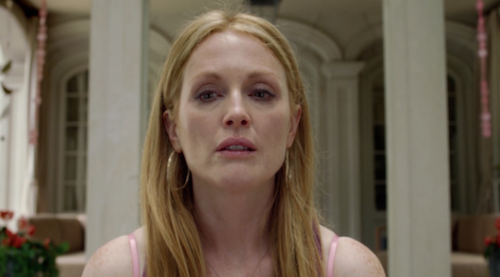
The film is already walking along a path to success like D’Arrietta’s first film, Moeder, which won best Australian documentary short and audience choice at the World of Women film festival, screened at DOC NYC, EDIN DOCS (part of the Edinburgh Festival UK), Aesthetica in the UK, the Portland Oregon Women’s Film Festival and the Women, Action & The Media Film Festival in the US.
Beverly stars AACTA and Logie winner, Susie Porter, and is being championed by Jackie Weaver.
“The point I think is that it’s about content, Australian content on Australian platforms. But also, the rude truth is that female filmmakers have many more obstacles to doing that. So, like all industries, it can be a disrupted pathway. More emphasis on supporting Australian female storytellers can only be a good thing for the industry as a whole,” Weaver commented.
D’Arrietta also has the support of Curious. Both she and Curious have joined Alma Har’el’s Free The Bid and Curious managing director and executive producer, Matt Noonan, confirmed that he is aiming for a 50-50 gender spread in his directors by 2019.
The Stable asked D’Arrietta, “What made you join Free the Bid? What are some of the toughest things you’ve had to confront trying to work as a woman director – in film and in advertising?”
D’Arrietta: I think Free the Bid is a really important initiative to shine a light on the huge amount of female talent available globally to advertising agencies. It also builds women up, which is vital.
It has to be tough when your accomplishments are seen against a background in which 1. you’re a woman and 2. you’re in a world fighting for women’s equality. So what happens when you assess D’Arrietta as a director instead of a female director?
She worked her way to commercials and film director on major projects, beginning her career as a stylist.
D’Arrietta: I come from directing in a very visual way, which I don’t think is a bad thing. As a stylist, I got to work on huge productions like the latest Top of the Lake and the mini-series, Wake in Fright. My time in costume departments really exposed me to the machine that is filmmaking or production. Costume taught me about the visual representations of characters, colours, textures. What certain things mean. I think it’s really been invaluable.
She has a distinctive quality to her work.
D’Arrietta: When I made the General Pants spots I knew that I really wanted to make them visually interesting. Give them a look that would be distinct. I think this is so important and often not developed enough by many directors. It’s so important when you’re talking about advertising because you have such a short time to grab the audience.
She is finessing her trademark style.
D’Arrietta: I also really like to make things that are humorous and it doesn’t necessarily have to be in a laugh out loud kind of way but can be really based in making the odd ordinary. Putting things together that may normally not go together to discover an off-kilter sense of humour. I think you can see this in many of my content spots – General Pants, Field Day and even my music videos.
I like to talk about dark subjects with a smile. Nothing should be taken too seriously. One of my music videos centres around a dead girl coming back to life at her own funeral. If that’s not dark comedy I don’t know what is.
And likes to break new ground.
D’Arrietta’s General Pants online content films, made with agency, stand out for D’Arrietta not only because “they really gave me chance at the beginning which was great”. They were strikingly different at a time when fashion films were following a rather dull format. Trailblazing, perhaps? Watch:
Her favourite work, though, is more recent – the spots she made for Field Day. “I think they’re clever considering the resources we had – which were few,” she explained.
“A lesson in making the most out of a small budget. They were incredibly fun to make, which I think shows, and I particularly love the actors in this campaign. Everything is always in the casting.”
But, yes, as a female director she had to come equipped with even more tenacity, desire and determination than many young talents.
D’Arrietta: I was working at a production company, just in a front of house capacity, and I showed one of the directors there my latest work. He immediately said something along the lines of, “for your next project it would be cool if you didn’t know that you were a female director. In this one you can tell, but it would be great if you didn’t know.” I understood what he meant and at the time I nodded away. But later, when I was thinking about it, I realised that it’s so messed up that I can’t even develop my own voice within my own gender. If anything, we need more things that DO seem like they’re directed by women.
Another difficulty in being a female is having to work on scripts in which women are not represented the way you would want them to be. You’re already trying not to rock the boat when you’re treating on things and this just adds another layer of difficulty. And then there’s the fact that you really have to work at how you deal with everyone on the team. If you were a man, you could be decisive and blunt. But as a woman, both of these are taken the wrong way in my experience. I was once called hard to work with but at the end of the day it was because I really cared about the work. If I was a man, my determination to do great work would have been seen for what it is.
I think men are taken more seriously the minute they walk in the door. What’s that saying – women are judged on their experience and men are judged on their potential?
View D’Arrietta’s reel here. View her website here.
Help to fund Beverly? Do that here.
You might also like