
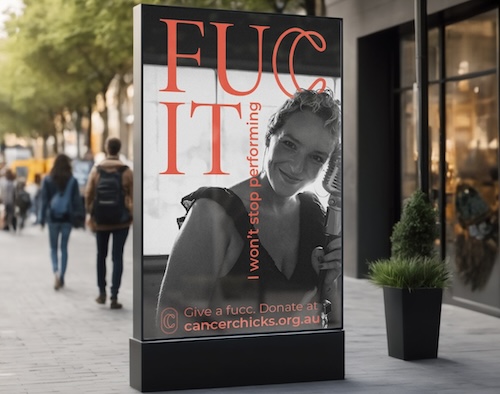
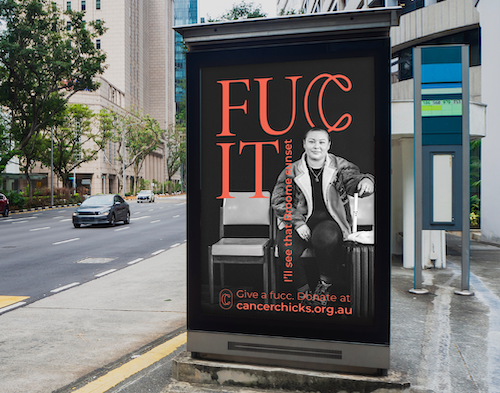
Cancer Chicks, MBCS and Initiative IMPACT demand that you pay attention to its new campaign to fuel support for young women with cancer. It’s called FUCC It, and it has an attitude that matches the phrase.
The campaign wants FUCC It to become the cultural catchcry for young women not to not let cancer, severe chronic and terminal illness define their lives.
Marshall Campbell, general manager, MBCS, said the team knew a provocative idea was needed to cut through charity clutter and empower these remarkable young women, who despite their diagnosis don’t want to be seen as different or treated differently.
At the core of the campaign is a 30-sec hero video featuring Cancer Chick brand ambassadors, Sharni, Rhiannon and Carlina, all everyday mothers, sisters, friends and colleagues, but with a cancer diagnosis in common, and all sharing an inspirational attitude. The videos show the women experiencing a FUCC It moment when they realise the need to escape the confines of their homes, hospitals and cancer treatment and live life as they want to.
Marshall Campbell took The Stable behind the scenes of the campaign:
A recent British cancer OOH campaign (Cancer won’t be the last thing that F***s me) built around the F-word was banned. Will it matter if you if your campaign is?
Marshall Campbell: While using a swear work is intended to be attention-grabbing, the deeper purpose is to connect authentically with our audience. Having personally witnessed the impact of cancer on loved ones, I know first-hand that phrases like FUCC IT are often uttered in moments of frustration and defiance. I anticipate that our audience, particularly those directly affected by cancer, will resonate with this raw and unfiltered expression (or at least we hope they will). In any campaign, it’s impossible to please everyone, and there may indeed be complaints. However, our primary goal isn’t to offend but to empower these courageous women and unite them in rejecting the limitations imposed by a cancer diagnosis. We want to inspire them to fight against cancer collectively and redefine their own narratives beyond illness. This campaign is about fostering strength, solidarity, and resilience within the Cancer Chicks community.
Where did the idea for the defiant attitude about cancer come from?
Marshall Campbell: I think firstly, nobody ever wants to embrace or celebrate cancer, it’s a horrible, disease that effects billions. The idea for this defiant attitude towards cancer stems from a profound understanding of the challenges faced by these young women. It’s inspired by real experiences of resilience and determination in the face of adversity.
The Cancer Chicks community is built on the shared belief that a cancer diagnosis doesn’t define a person or dictate their future. These women choose to confront cancer with a spirit of defiance and empowerment. This attitude emerges from a desire to reclaim control over their lives and refuse to be defined by their illness. Ultimately, the idea of defiance comes from a place of deep empathy and solidarity with those navigating the complexities of cancer. It’s about celebrating courage, strength, and the refusal to let cancer overshadow their dreams and aspirations.
What does the media support entail? Were there any refusals to use the content?
Marshall Campbell: We are absolutely blown away by the incredible support we’ve received from media publishers, amounting to millions in value. It’s truly beyond belief and a testament to the importance of our cause. We’re thrilled to see our creative work, designed for social, have the opportunity to run in mainstream ATL channels like TV. While the FUCC IT message resonates strongly within our target audience, we recognise that certain platforms, such as shopping centres and family-oriented broadcast TV slots, cater to audiences with different sensitivities. With these publishers, we developed a more nuanced approach to ensure our message remained impactful without causing unintended discomfort or controversy. By strategically tailoring our creative execution to suit each platform (while staying true to our empowering message), we have effectively leveraged this valuable media support to inspire and unite individuals in the fight against cancer.
How difficult was it to find a balance of emotion in the content – how was it achieved? What were some of the tactics used for added impact?
Marshall Campbell: Finding the right balance of emotion in our campaign was a deliberate and thoughtful process. While discussing cancer, it’s tempting to dwell on the sadness and challenges, but we understood the importance of showcasing the incredible resilience and success stories of the women within our community. Cancer Chicks was founded to provide a supportive community for these remarkable young women, emphasising belonging and support. Therefore, our creative approach needed to highlight the amazing personalities and individual narratives of real Cancer Chicks. Our goal was to shine a spotlight on the strength and empowerment that emerges from overcoming adversity.
To convey this effectively, we used a combination of black-and-white and colour visuals. This creative approach allowed us to transition from moments of reflection to highlighting the positive impact of organisations like Cancer Chicks. We are immensely grateful to our three young women who served as the talent in our creative. Their willingness to open up and share their stories not only allows us to celebrate their journey but to highlight the transformative impact of Cancer Chicks on their lives.
What are the aims of the campaign?
Marshall Campbell: Our campaign’s primary objectives are to raise awareness and garner support for Cancer Chicks, a vital charity filling a critical need for young women affected by cancer. We aim to highlight Cancer Chicks’ services through compelling storytelling and visuals, shedding light on the challenges faced by these women and the empowerment found within the supportive community.
Additionally, our campaign emphasises the importance of community and solidarity in the cancer journey. Whether individuals are facing cancer themselves or supporting someone who is, we want them to know that Cancer Chicks offers a welcoming and understanding network. Together, we can provide essential support, companionship, and hope to those impacted by cancer.
Rikki Stern, co-founder of Cancer Chicks and survivor of Hodgkins Lymphoma, stated, “There is no better brand positioning for Cancer Chicks. Every woman I know who has been diagnosed with cancer has had their FUCC It moment that has inspired them to move beyond being a ‘woman with cancer, to a woman who is proud to be who they are, cancer or not. We are so excited to see FUCC It out in market and can’t wait for the conversations to begin.
FUCC It launched on April 24 and runs for six weeks.
Credits:
Client: Cancer Chicks
Rikki Stern: Co-Founder of Cancer Chicks
Melissa Fein: Board Member & Initiative Australia CEO
Michele Molnar: Co-Founder of Cancer Chicks
Katrina Konstas: Board Member of Cancer Chicks
Kiki Paul: Board Member of Cancer Chicks
Adele Greenberg: Board Member of Cancer Chicks
Tresna Karras: Board Member of Cancer Chicks
Creative Agency: MBCS
General Manager: Marshall Campbell
Group Creative Director: Luke Simkins
Creative Director: Shanan Goldring
Senior Producer: Livia Canto
Director & Editor: Jacob Abi @ Arrage
Copywriter: Abby Clark
Art Director: Laura Murphy
Grade: Ryan Beetson
DOP: Jonathan Baker
Stills Photographer: Nadia Stone
Collaboration with MIK Studios
Media Agency: Initiative
Chris Colter: Chief Strategy & Product Officer
Danielle Galipienzo: Head of Initiative Impact
Triere Anthony & Sarah Moore: Client Directors
Summer Treseder: Strategy Manager