

Humans are very bad a dealing with their trash. Throwing it out without thought has polluted the planet and now it’s polluting space.
There are over 160 million pieces of human-made space debris in the Earth’s orbit, from defunct, human-made objects such as remains of rockets and satellites. As they travel at high speeds of 15 kilometres per second, even a small piece can cause significant damage. Space pollution threatens to destroy satellites and other space infrastructure crucial for life on Earth, such as telecommunication, navigation, disaster management, environment protection, agriculture, financial services, and more.
Serviceplan, design studio, Moby Digg; visual artist, Frank Gräfe; sound designer, Jürgen Branz; and CGI artists, Non Zero Space have created an awareness campaign to try to halt space pollution ahead of the United Nations Committee on the Peaceful Uses of Outer Space (UN COPUOS) session in June 2024.
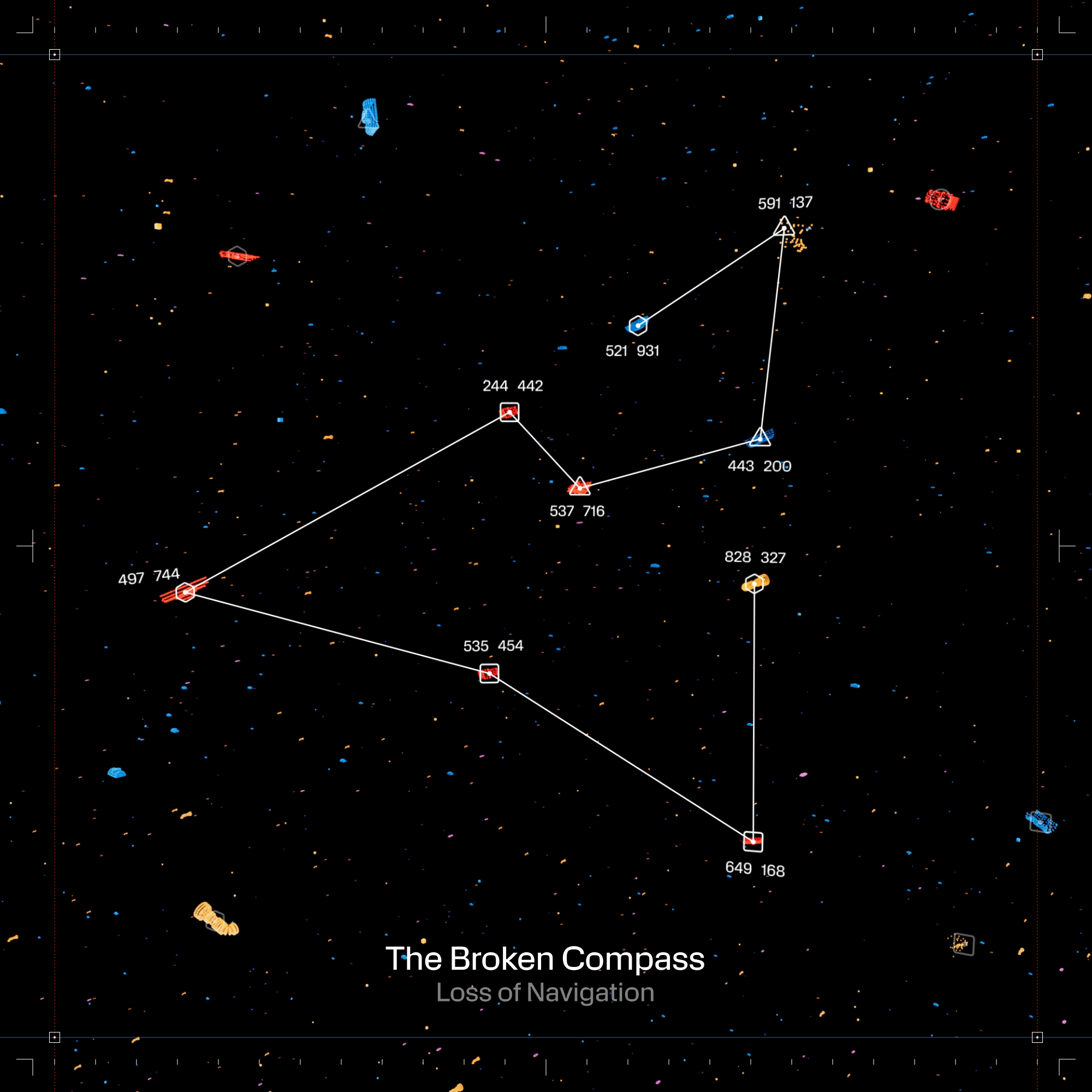
Space Trash Signs campaign has launched with the support of aerospace companies and space agencies, scientists and universities, as well as activists, museums and media from around the world. The initiative makes space pollution known by naming it as new astronomical constellations. Each of these “trash signs” represents a different impact of space pollution.
For example, The Broken Compass signifies the loss of navigation services such as GPS, that would affect 6.5 billion people and make modern aviation impossible. The Great 404, named after the ‘page not found’ error in the web browser, signifies limited internet, impacting 43 million people who rely on satellite internet, potentially isolating whole communities. The Lost Harvest stands for the loss of environmental data that can only be collected through satellites, affecting 509.6 million square kilometers of land and potentially causing famine and environmental disasters.
Alex Schill, chief creative officer, Serviceplan Group, explained “Since the dawn of time, humans have looked up to the stars for meaning. Space Trash Signs builds on this universal insight, to educate the public about space pollution — a topic that affects us greatly, yet no one talks about. It’s our responsibility as communication experts to change that.”
The Space Trash Signs were identified in partnership with Steve Wozniak co-founded space monitoring company, Privateer, that collects over 800 million data points on objects in the Earth’s orbit every day. This includes the position, speed, country of origin, parent object, size, shape, and even the estimate removal. AI was then used to find visual patterns of debris over areas linked to the consequences. For example, The Lost Harvest, was located over the Amazon rainforest, the world’s most biodiverse region; The Great 404 over Burundi, Central Africa, the country with the lowest number of internet users; The Broken Compass over the infamous Bermuda Triangle in the North Atlantic.
Space Trash Signs are then brought to life for the whole world to experience in over 700 planetariums worldwide through partnerships. The signs are also integrated into popular AR star-gazing apps. Furthermore, a digital campaign confronts people with the consequences of space pollution through staged website error pages, failed parcel tracking or missing forecasts. All lead to the Space Trash Signs website, where every sign can be explored along with more data, background information and ways to act, such as signing the Zero Debris Charter facilitated by the European Space Agency and co-developed with more than forty space actors around the world.
TheSpace Trash Signs platform is open to any private or public organisation as well as individuals who want to join the fight against space pollution. Experts from European Space Agency have recognißed the important contribution of Space Trash Signs to raise awareness on the issue of space debris. Other prominent supporters include the German scientific aerospace association WARR, Japanese founded, global debris-removal innovator Astroscale, several space-debris related startups such as OKAPI:Orbits from Germany, Dark Space from France and Digantara from India, global astronomical society Astronomers Without Borders, as well as the world’s biggest science museum Deutsches Museum in Munich.
“There are some internationally agreed upon guidelines on debris clean-up and prevention. But none of these mechanisms has enforceability,” warned Dr Moriba Jah, chief scientist at Privateer. “If we don’t change our behaviour, space will become unusable.”
“Space Trash Signs makes this huge problem of space debris tangible to the public. It’s important for ESA to recognise the role of such initiatives to educate people about space debris and unite us all for a zero debris future,” added Dr Quentin Verspieren, space safety programme coordinator at the European Space Agency.