A Kintsugi-style mural by artist, Joe Caslin, in Dublin leads a campaign to show the Irish how talking and being listened to helps the process of mending. The ancient Japanese art of Kintsugi is used as a visual metaphor to drive awareness of the Samaritan’s round-the-clock provision of services and support to those who need it most.
Kintsugi is a centuries-old artistic practice meaning ‘golden joinery’. It involves repairing ceramics that have fallen into disrepair with lacquer and gold. In parallel, human lives can be similarly infused with fragility, setbacks and unpredictability – even at the best of times. But lives, like ceramics can be repaired and pieced back together with even more beauty.
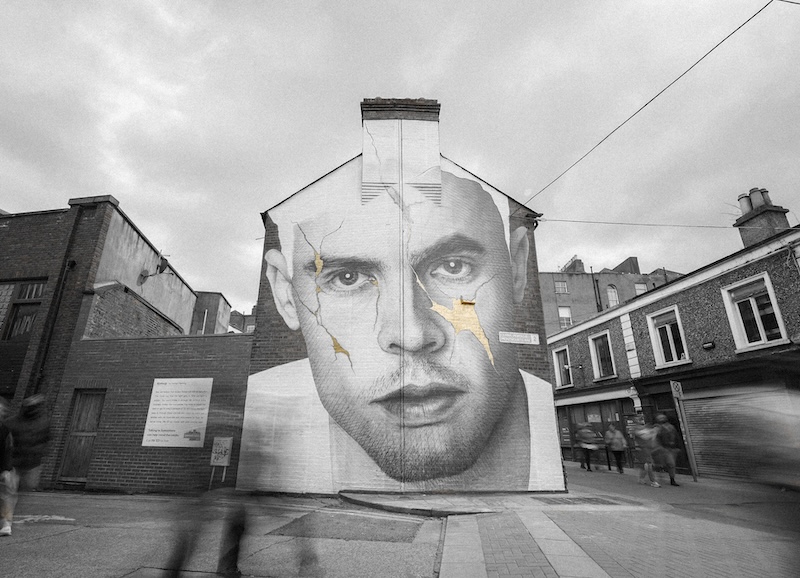
The idea became the foundation of TBWA\Dublin’s campaign, built around a portrait of Daragh Fleming on a wall on Montague Lane, that was specifically chosen for its pre-existing cracks. The public saw it as just a cracked mural for a week, as they travelled through the busy walkway. It was only after that week that the cracks were filled with gold, transforming the portrait into something more than a sum of its parts, and enforcing the message that cracks can be more than repaired through talking, and being listened to, by the Dublin Samaritans.
At a time of severe cost of living crisis, and global conflict, there are a multitude of factors that can impact mental health. St. Patrick’s Mental Health Services’s 2022 survey revealed that 22% of people in Ireland would perceive it as a sign of weakness if they sought help for their mental health. Meanwhile, only 6% would consider it a weakness if a friend sought help.
Bolt, TBWA\DUBLIN’s in-house production company, tells this story in a 60-second hero video, in which it is clear the Dublin Samaritans have touched the lives of many. The poem accompanying the video is written and read by Daragh, who is the subject of the portrait, and has in the past used the services provided by the Dublin Samaritans. Electronic musician and DJ-duo Bicep also generously provided their track, free of charge.
“Dublin Samaritans gives so many people a listening ear, some time to be free of judgement, and to be themselves – cracks and all. These rifts and fractures contribute to our being. They’re not something to be ashamed of, but it’s part of the history that forms who we are each day. Whether it’s the cracks in a building like the ones in our mural, or the cracks in oneself, each one has a story. And Dublin Samaritans is open to listening to each and every story along the streets of Dublin. And that’s what led us to our campaign, Talking Can Help Mend. And we’d like to thank everyone who lent a helping hand, and an ear, along the way,” stated Leona Smyth, art director at TBWA\Dublin
Yvonne Caplice, business director, TBWA\Dublin added, “We all have been broken along the way – some of us experience it for longer, some of us experience it deeper, and some of us are broken right now. We must be mindful that being broken is a natural part of our human experience – and speaking about it helps. It is crucial that we eliminate the shame associated with our struggles and empower people to express themselves openly.”
Olwyn Greene, director of awareness for Dublin Samaritans, commented, “From the first day that TBWA presented this concept as the new awareness campaign for Dublin Samaritans, I loved it . The symbolism is so powerful. We are embracing our imperfections. We are becoming more valuable because of facing and overcoming our difficulties.”
At a time of severe cost of living crisis, and global conflict, there are a multitude of factors that can impact mental health. St. Patrick’s Mental Health Services’s 2022 survey revealed that 22% of people in Ireland would perceive it as a sign of weakness if they sought help for their mental health. Meanwhile, only 6% would consider it a weakness if a friend sought help. It’s this disparity that TBWA\Dublin and the Dublin Samaritans want to help tackle with this campaign.
The full campaign also covers social, DOOH and radio.