Tim Lindsay is in his element at this year’s D&AD. Every morning, there are queues to get in. The talks and workshops are full. The big kids are all here. The judges are wandering ambassadors for its ultra-high standards and therefore the prestige of its Pencils.
And last night he stood centre stage in a packed Adobe Theatre to announce that D&AD Festival had made a partnership that not only changes the game for the festival, it promises to changes the game for creativity and culture.
The Stable: In November you told me, “the old men have to go.” They have. What the hell’s going on?
Tim Lindsay: (Laughs. Thank heavens: ed) What I actually said was that trying to get people of my generation to change their minds and then change their behaviour was not necessarily the best use of people’s time and effort. Because we’re going. If we’re not gone, we’re going. And the people who are leading the industry now are younger, in their forties or fifties. The energy should be focussed in these people with power, the Alis (Hanan), Taras (McKenty) and Stefs (DiGiavincenzo) of this world. Not old people like me.
What’s going on? There are huge financial pressures. Those are the people who are paid the most. Why pay someone £200,000 when you can get someone younger and more energetic to do the same job for less. And it is ageist but it is also a fact. It is a young person’s game. Older people do have a value and some of them do stay in the business after fifty, but if you find yourself looking for a job at that age it is, I’m afraid, very difficult.
“The work that has been awarded is pretty damn fantastic.”
TS: Creativity is under an awful lot of pressure. Was that reflected in this year’s entries?
TL: I haven’t been that optimistic about the quality of this year’s Pencils but we maintain a pretty inflexible standard at D&AD. Obviously, it fluctuates, depending on who’s judging but our jurors come here, in fact, grimly determined to uphold the tradition of being very tough on the work. And, as you know, we don’t have any quotas so there are always a couple of categories in which there are no Pencils. Press was one this year.
But the work that has been awarded is pretty damn fantastic. At the Black Pencil judging we review all the Yellow Pencils and there is some absolutely stunning stuff in there. I think what might be happening, because I think there is less great work around, is that the depth was not there as much as it might be. But I have no statistical proof of that.
“For us at D&AD, Guardian is rocket fuel.”
TS: What does the Guardian partnership mean to D&AD?
TL: There are a number of factors here. Firstly, Guardian Media Group were shareholders in Essential before they divested a little while ago and so they know what is good and bad about festivals because they’ve seen first-hand.
Also, this is a commercial venture primarily. They’re not doing it for brand building purposes. (Equally, they wouldn’t lend their name to anything was damaging to their brand.) It’s not a media partnership. It’s more than that. We’re very similar in many ways. Their ownership structure culminates in something called stock trust and its job is to keep publishing The Guardian and The Agenda. That’s what it’s there for. It’s public knowledge that Guardian has lost a lot of money over the last couple of years and the job of David Pemsel, CEO of Guardian Media Group, is to mitigate and eventually stroke those losses and hopefully turn them into profit. And he’s doing a brilliant job. So they see this as something they know about, that they can get behind wholeheartedly. They see that D&AD and Guardian share a lot of values. We’re simply here to promote and stimulate creative excellence because we believe it creates better outcomes, and they’re there for free and independent journalism.
The other factor is that their audience is very much our audience and they’re a significant player in our three top markets – the UK, Australia and America. They are the third biggest news brand there. It’s a business opportunity. There’s a brand opportunity. And for us at D&AD, they are rocket fuel. They allow us to get out from our conventional constituency, advertising and design and reach out into the creative diasporo. The whole definition of creativity and where it happens is changing very rapidly, and as it disperses it gets harder for us to access. So it gets harder for us to provide a proper service to the community because it’s so dispersed. The Guardian will help us do that properly.
The final thing is that London, for all its Brexit and other issues, is still arguably the world capital of creative. It’s got fantastic art, film, television and theatre, food, advertising, design and architecture. And people like coming to London because it’s a pretty cool city. We’re also in a cool part of it here in Shoreditch. So you could say, and this is how I think, London needs and deserves a really great festival of creativity and contemporary culture and this is going to do it.
Business leaders and practitioners who put creativity, technology and innovation at the heart of their business, and increasingly that’s everyone, know that the most powerful things in your business are creativity and innovation. Without those you don’t go anywhere. So the new festival will celebrate that and join the links that exist there.
“White blokes in creative departments writing knob gags are just not that interesting after a while.”
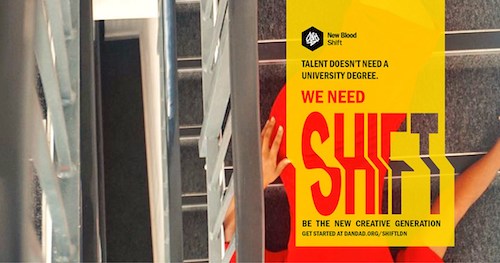
TS: Shift is D&AD’s new baby? Why is it important for you to have another educational arm?
TL: We’ve run Shift three times now. Twice in London and once in New York – absolutely with the support of the community. They provide the teachers, the mentors, the space, the food, the drink and we provide the pastoral care, the curriculum and the expertise in terms of identifying who we are going to put through the programme. The qualification is that you have to be a creative practitioner but not have found your way into the business and not have a degree. So the only qualification is you’re not allowed to have a qualification. You might be doing photography or street fashion, street art, vlgging or blogging. These are not people who have never tested their creative prowess but they’re not making a living at it.
It’s a twelve-week night school. We make it a night school so they don’t have to give up their day job. They don’t have to roll the dice at the beginning – although they might at the end, with a placement. We teach them basic ideation techniques and presentation. We tell them what’s expected of people who work in agencies and studios because many of them have no role models. Most don’t even know anyone who works in an office. And there’s the pastoral care side of it – really simple stuff like getting to work on time. That takes up a lot of time and is therefore expensive. The teaching part of it, the industry does for us.
We’ve put about fifty people through the three iterations and a lot of them have got jobs in the industry. Nearly all of them who wanted it got a placement or internship. Six of them have made films. One of them has been awarded. Four of them have decided that they will go to further education. So it’s kind of life-changing for pretty much all of them. We want to expand it. There will be a digital version of it one day. At the moment the fact that’s it’s face to face is an important part of it, which limits us to doing it in big cities. We would love to do it in Sydney. The wonderful JK (Jonathan Kneebone) wants to make it happen. When we get the money, that will be the next place we go.
We want Shift to be copied. We can’t do it everywhere but what we’ve shown is that there is this vast talent pool – that everyone knows about – but you can tap into it. And the business needs multiculturalism. It needs more diversity. It needs people from different backgrounds because that’s who we are selling to. So this white, male, middle-class thing, that’s got worse not better, is just bad for the fucking business. Never mind social justice and giving people opportunities and all that, it’s just bad for business. And it’s bad for creative excellence as well, which is kind of where we arrive. Homogenised communities produce homogenised solutions.
You might also like