[by Candide McDonald, editor, The Stable.]
Lindsay has no fear. In fact, he boldly goes where agencies fear to tread. D&AD planted the seeds of doing good work for good – which led to the launch of White Pencil – five years ago, at a time when the only motive for an agency to do great work was to sell stuff and keep that agency’s business thriving. Lindsay’s passion for promoting good work that does good is unabated. The D&AD Impact Awards attest to this. But now he has also turned his attention to a cause that’s much less popular and much harder to get his industry to embrace – diversity.
Why does adland think diversity doesn’t matter?
Achieving real diversity in the industry, rather than making episodic displays of it, is unpopular because, Lindsay notes astutely, “the patriarchy has it pretty good. Even people who understand they are part of the problem are often not willing to be part of the solution.”
Yes, the industry that touts bravery and lives and dies on its creativity is, as Lindsay puts it, “innately conservative and only changes when it’s forced to. That usually means because clients require it,” and as Lindsay points out, the client world – indeed the world itself – is largely run by a patriarchy too.

The advertising industry, Lindsay notes, is actually less diverse in many respects than it was decades ago. So the solution to getting the industry to do more than pay lip service to being representative of the audience it talks to is…? Well, there’s one obvious one, and only Lindsay would state it. “I think with people like me,” he says, referring to the old guard (but not himself, he adds with a smile), “coming to the end of their careers, it’s largely a waste of time. They have to go. Younger blokes – and blokes are very important in this because they have to get with the programme and do shit, as opposed to just talking about it. And that involves childcare, cooking and picking the kids up from school. The practical things are hugely fucking important. I think the old generation has reaped the benefit of being part of the patriarchy and won’t change their views. Not really. Younger guys are much more open to diversity, understand it’s a problem and are willing to do something as opposed to just talking.”
Of course, diversity is not just about gender balance. And this, Lindsay stresses is part of the problem. Diversity is a lot of different issues – gender balance, ethnic and demographic diversity among them – each with different causes and different solutions.
What does advertising gain by being diverse?
“Obviously, there are huge political, cultural, social and economic issues involved here and this is about much more than advertising. It’s about humanity and life. But the reason adland has to become more diverse is not social justice. It’s business.” Homogenous groups produce homogenous ideas and when those groups are ad people, that’s not good for clients, who are not selling to homogenous audiences. “Advertising has to produce ideas that solve business problems that involve diverse audiences and there’s tons of evidence to show that more diverse companies outperform their competitors.”

Why is it important to D&AD to have a diverse industry?
In essence, it’s because that is D&AD’s purpose, Lindsay explains. While D&AD is synonymous with congratulations in your mind and my mind, it is in fact an educational charity whose stated mission is to stimulate the industry, “forcing the industry,” he adds, “to do better work. Because the good stuff has better outcomes and if you’re going to do something you may as well do it well.
“Because diversity is so important to effectiveness and increasing effectiveness is a very important part of what we stand for.”
Moving and shaking frightened agencies
For all their overt advocacy of brave ideas, agencies are far too frightened of internal change and by what they think their clients want. That’s not Lindsay’s stated view. It’s that of advertising’s greatest fan – me. He doesn’t think they’re brave. And he does point out that, for example, there are far fewer LGBTQ people in the advertising industry than the proportion in the general population. And that’s just odd for an industry that makes a very big show of supporting LGBTQ. They good at paying service to diversity.
So Lindsay is in Sydney to help advertising to get over fear. One effort is to help Google creative director, Tara McKenty and Clemenger BBDO Melbourne creative director, Stefanie DiGiavincenzo, launch RARE in Australia with The Glue Society’s Jonathan Kneebone, who Lindsay stresses “supports the industry in Australia and elsewhere unbelievably with is generosity, his time and his premises”. D&AD supports and has co-authored this movement, that aims to change diversity in advertising creative departments. Change it effectively, Lindsay, explains, by creating a collection of adpeople, “mostly but not all women, and giving them the understanding and the skills to become a cohort that will go on to become increasingly senior and increasingly powerful in the industry and stay in touch with each other because together they can do more.”

Trying to bring a competitive industry together to tackle diversity is another of Lindsay’s current efforts. “Even some of the more well-intentioned initiatives founder,” he notes. And that’s because the efforts are scattered. “They don’t join up and so the whole is less than the sum of the parts. They should combine – not merge, he restates – but if someone is doing something well, there’s no point duplicating it. You have to support it. The whole will then be greater than the sum of its parts and in diversity, that’s what’s needed.”
Lindsay’s third effort is for the D&AD New Blood Brief to Broadcast programme. When I arrive at The Glue Society to interview Lindsay, he and Kneebone are holding about thirty young creatives in their thrall. It’s the programme’s midway coaching speech. They’re inordinately charismatic, but they’re also rather adept as mentors. These kids have just four hours to turn the embryonic ideas they’ve conceived in four hours this morning into campaigns. “Don’t panic,” they encourage, “a group last year came up with an idea moments before the end and that made all the difference.”
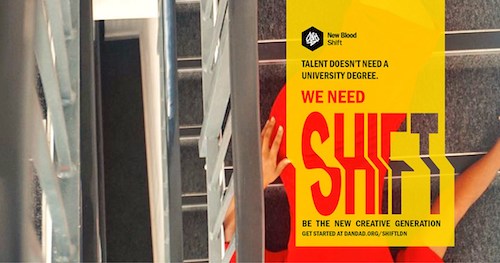
New Blood isn’t D&AD’s diversity programme for young people. But D&AD does have one. It’s called Shift, and it finds people who are not using their creative talent in their careers because they haven’t had the means to do so, and gives them the means. In its first iteration in London, D&AD put through 17 people “from an unbelievable diversity of backgrounds,” Lindsay states. “I’m so proud to say that eleven are now involved in the industry and being paid, and none of them would be without Shift.” D&AD hopes to make Shift, which has run in London and New York, international. “Sydney would absolutely be the next on our list and I’ve been talking to people about it here. It depends on the community for teachers, mentors, space, support. The communities in London and New York have embraced it wholeheartedly. I feel the same would happen here. When we get the funding, it will happen.