The Most Powerful Arm for Save Our Sons has won its Black Pencil in Technological Innovation. Havas and Finch share their kudos with Reactive and The Red Agency for this campaign.
If you still don’t know its story, here it is:
Save Our Sons is a very small charity. Its cause, Duchenne muscular dystrophy only affects boys, and then just 1 in 3,500. But it’s a horrid disease, a fatal muscle degenerating disease.
The Most Powerful Arm Ever Invented was at once a big ad idea, an education and awareness tool, and a very cool metaphor for what the campaign was able to do for the cause. The charity had raised $1.75 million in Australia towards funding clinical trials of a new treatment and needed government to provide the remaining funds needed. The government was not in the mood to be bugged for funds for a disease hardly anyone knew existed. The campaign needed first to get the public behind the cause.
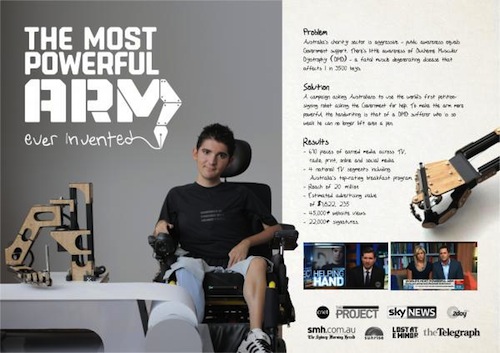
So, The Most Powerful Arm Ever, was invented. It’s a world first robot arm that – via its online hub, TheMostPowerfulArm.com – physically signs a petition for anyone wanting to help kids with DMD.

With a simple click, Australians could see their name signed in real time in support of the cause then posted to their Facebook page to spread the message.
TheMostPowerfulArm.com had zero budget for bought media. PR and social media were the only promotional tools it could use for awareness and action.
DMD sufferer, Jacob Lancaster, was appointed as the face and spokesperson, and he became the focus of the 6 minute video on the website. The font created for the robot arm was taken from the last piece of handwriting Jacob created before he lost the ability to write, a Mother’s Day card, strengthening the arm’s personal message and significance.
During the campaign, 193 media articles and 6 pieces of national television coverage, were achieved by Havas’ Red Agency, with a combined reach of 20+million, and an advertising value of nearly $2m.
There were 1,130 mentions posts across blogs, Twitter and Facebook reaching an audience of 3+ million.
45,000 website views were received and the robot signed 32,000+ signatures.
Getting signatures was the aim of the campaign, but it also generated more than $24,000 in donations for the charity.
And the campaign achieved its goal. The Australian Government noticed. The petition was passed to Tanya Plibersik, Federal Minister for Health and Medical Research, in May 2013.
You might also like