In 2010, Unilever and D&AD got together and began talking about doing good. That year, Unilever launched its Sustainable Living Plan, which set out clear goals for the company to improve the planet. The next year, D&AD launched White Pencil, with Peace One Day, that campaigns for all hostilities in the world to stop on September 21 each year, the client for its first brief.
The White Pencil was introduced formally into the D&AD Awards in 2012, the year of D&AD’s 50th anniversary.
Meanwhile, advertising and brands got the hang of doing great work for good. White Pencil grew and grew. In 2016, D&AD launched a stand-alone awards programme for good, D&AD Impact, with Advertising Week, because “the role that businesses and brands play within society, the economy, the environment and culture has never been more important.” [Tim Lindsay, chief executive officer, D&AD]
It, too, has grown and grown.
Australia’s Paula Taylor is global development director of D&AD whose key role is to accelerate growth and reach for D&AD Impact. The Stable asked her about this year’s developments and to share her favourite Impact winners.
Paula Taylor: Going into year three of the program, we’re doing things a little bit differently to broaden the scope of projects we look at and provide more ongoing support for those projects. The main changes are the additions of the D&AD Impact Council and The Academy.
The Council is made up of leaders from across a wide range of sectors, from the creative industries, to technology, venture funds, social entrepreneurs and NGOs. Members of the Council are global ambassadors for the program. They judge the awards and commit to supporting Impact winners, through access to training, expertise, contacts and mentorship.
The Academy exists to inspire and educate future change makers, giving them the networks and knowledge they need to bring purpose front and centre. This year, it will be running a two-day masterclass program in September in New York during the UN General Assembly Week and we will be inviting shortlisted D&AD Impact winners to participate.
The Stable: What are your three favourite D&AD Impact winners?
PT: My first pick has to be JWT Amsterdam’s School for Justice. There are nearly 3 million sex workers in India and 40% of them are children or adolescent girls. So few of the criminals responsible are punished. In 2015 there were 1.2 million girls in forced prostitution. Just 55 cases led to convictions. So JWT Amsterdam and the Free A Girl Movement opened the School for Justice to teach law to victims of child prostitution in 2017.
Its aim was to give these young women the education they need, and therefore the power they must have, to fight the injustice of child prostitution and prosecute the people who abused them.
This is its case study:
My second and third are both work for Syrian refugees, a problem due to war that is causing its own battles. Syrians are the largest refugee group in the world. Nearly half of the country’s population has had to leave their homes.
Searching for Syria was created by the United Nations High Commissioner for Refugees (UNHCR) and Google. It’s a responsive, interactive website, that threads imagery, film, sound, data visualisations, maps and satellite imagery into human stories to answer the five most often asked questions that people around the world are asking the internet about the crisis.
https://www.youtube.com/watch?v=0E8JD8BItRc
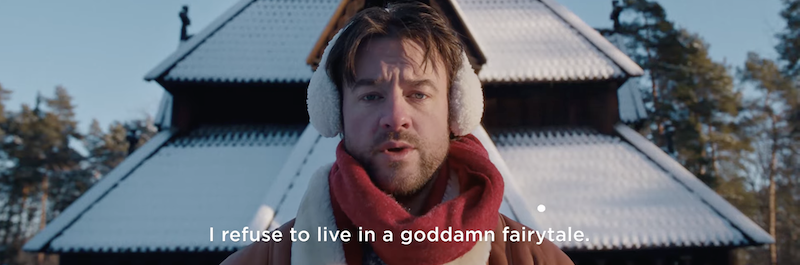
The third is 25m2 SYRIA by agency, Pol, for TV-Aksjonen NRK & Red Cross Norway. It’s a brilliantly tangible way to help people understand what it’s like to live in a war-torn country. 25m2 SYRIA is an apartment – an apartment built inside Ikea’s Norwegian flagship store. It’s 25 square metres in size and it’s an exact replica of a real home in Damascus. The home in which a woman called Rana is trying to raise her four young children.