

Most people “sort of” know that sex trafficking probably occurs in their city. But because it’s covert, it is easy for people to pretend it’s not there or miss the signs altogether.
Human trafficking is not typically perceived to be a problem in Canada. Yet it is one of growing concern across the country. More than 90% of the victims of sex trafficking within Canada come from Canada, according to the National Action Plan to Combat Human Trafficking – 2012. Young Canadian girls of all socio-economic backgrounds, in big and small cities, are being recruited and forced into sex work.
“Human trafficking occurs closer to home than most Canadians realise, and the signs can be hard to identify or are easy to dismiss,” explained Sean Sportun, vice chair, Toronto Crime Stoppers.
“Moreover, with the legalisation of prostitution comes ambiguity over what is and isn’t a legal sexual service, making it difficult for everyday citizens to discern between a consenting sex worker and an exploited, abused and powerless victim.”
Toronto Crime Stoppers & Tribal Worldwide want people to assimilate the idea that human trafficking is happening close to them and show them what to do about it. It’s Toronto Crime Stoppers’ first campaign against human trafficking and will run for five weeks.
Knowing that hotels are one of the hot spots where sex trafficking occurs, the campaign uses search engine marketing to target people searching for hotel accommodation in the Greater Toronto Area to serve them digital banner ads for Hotel De Jeunesse, a fake hotel found online. At first glance, the site appears to be an innocuous hotel site, with nothing out of the ordinary. But, when you explore the site, it becomes clear to users that it’s not a real hotel but rather a tool to educate the public about how to recognise that sex trafficking is going on.
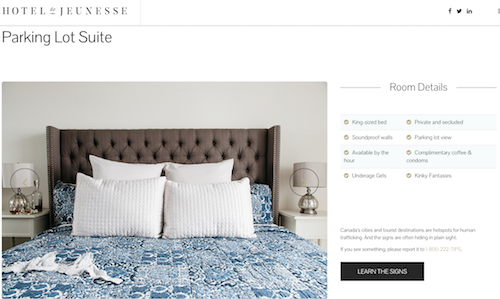
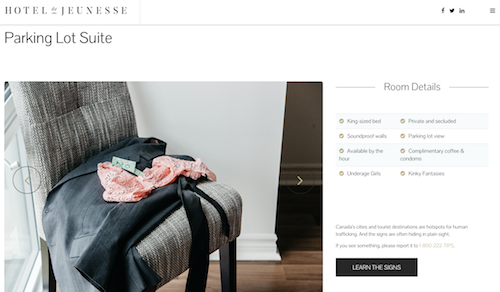
“We wanted to reach people right before they entered into a known human trafficking hotspot so they could help us fight this problem,” noted Marketa Krivy, executive creative director, Tribal Worldwide Toronto.

By creating a presence on travel-related platforms and in those micro-moments, we are able to unpack what signs to look for. The signs of human trafficking hide in plain sight and can be easily dismissed if you don’t know what to look for. But once you do, it becomes much harder to ignore.”
The campaign also includes out-of-home placements across the greater Toronto area – transit shelter ads, elevator advertising, TTC digital screens, advertising at gas stations and Mac’s convenience stores, and carousel ads on Facebook and Instagram targeting people with travel interests.
Here, the creative discreetly places the scenes and signs of human trafficking within the patterns of hotel room fabrics, including the wallpaper, bedding and drapes.

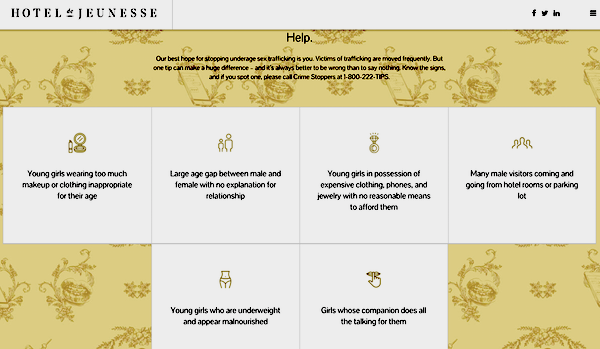
Explore the site to learn the clues that human trafficking is going on under your nose:
You might also like