The Martin Agency and Nick Ball have just solved adland’s biggest problem – creating the campaign that follows last year’s #1. Fast Forward is Geico’s first campaign for 2016 campaign. Last year’s Unskippable won a Cannes Grand Prix and two Gold Lions (Film & Cyber), two Gold Clios (Innovative and Digital) and made it Creativity’s #1 for Film/TV 2015 and Shots online film of the year. In its 20 years with The Martin Agency, the Government Employees Insurance Company, has gone from eighth to second in its category. Nick Ball talks about creating the campaign that follows last year’s #1. But first, a little background…
Solving the problem of pre-rolls, their low viewing rates, was obvious to The Martin Agency – make the first 5 seconds count. The agency went one step better for Geico insurance. It made the ads end in 5 seconds. Whatever happened in the next 30 to 60 seconds was bonus footage. Hilarious bonus footage, that generated 725,000 unaided YouTube views in one day.
This year, the agency has conquered a new problem. An online media buy without any skip buttons. How do you keep people from hating a pre-roll ad they’re forced to watch to the end? You fast-forward through it.

The Martin Agency has created four 15 second pre-roll ads that do just that. Each ad begins in a mundane situation then fast-forwards ahead to something much more unexpected. At the end, you can click to watch the unabridged version of the ad and see what you missed. The goal is to take the most annoying 15 seconds in advertising and turn it into something so entertaining, people actually choose to watch more.
Australian director, Nick Ball, got to direct all the ads in the Fast Forward campaign through Furlined.
Here is what he had to say about that:
What were your first thoughts about the concept?
Nick Ball: I pitched on Unskippable last year and it was super unique. I don’t think anyone had ever seen anything quite like it. When it came out, it cleaned up all over the place and became this kind of barnstorming campaign. So this one was almost that thing where you say to yourself, “I don’t want to do the bad sequel,” but it seemed even more sophisticated. The Martin Agency’s creative team of Neel Williams and Mauricio Mazzariol, led by Steve Bassett and Wade Alger, who did the original Unskippable campaign and this one…they’re so intelligent in the way they’re using the media. the technique and the device because it’s got a bit of a built-in audience this time around. I think that’s a huge benefit. From a storytelling point of view, Fast Forward opened up crazy opportunities for us, and for me it was about what could we do to make the opportunity as good as it could be. I reckon we’ve had a good chance to do that, which is great.
Knowing how they’re being used, did you have to approach these spots differently to other comedy scripts?
NB: On top of creating a narrative off the top, it was also about knowing what our last shot was, and creating a lure to make people click to see more. We would challenge ourselves, The Martin Agency’s creative team and I, to make sure that whatever we ended up with was engaging enough to make you click, to want to watch more. That was the trick. It’s different when you don’t know when you’re being advertised to. With this campaign, though, you get to choose whether you want to be advertised to and that’s so much more potent because it’s such an incredible thing to think people would choose to watch your ad instead of getting to their video on YouTube. In that respect, we just had to make sure that our final image was as interesting as we could make it. We had to get to a point where people would click to watch, which is a pretty rare thing. But, did I approach it any differently? Probably not. I think it was still just about making a world and engaging characters and making sure that the world felt watertight for each piece. The cool thing about the spots is they’re all quite different tonally. All four of them play in different areas. The guys and I were struck by the idea that if we could make all four feel very different, and have very different journeys for these characters and construct different worlds, it would have a greater reach for the campaign.
What was it like to make these spots?
NB: We were making stuff that you can only dream of making. It was like, “Can we do that?” “Yeah sure, there are no rules here.” I think that was probably the main thing. There was really no yardstick for any of this stuff. There’s no yardstick for a man and a bear who are brothers because they share the same birthmark, for example. If we thought it was funny we’d just do it. There was never any kind of point of reference, which is a really cool thing.
Did the spots change from the script as you were shooting them?
NB: Yeah, quite a bit. I had a pretty strong point of view on the worlds we were creating and feeling like there were layers that could be further developed. It felt to me as though you had to approach them like scenes in a film. If you’re getting people to engage voluntarily, then it’s an opportunity to make a little scene or a little movie. So it was always about how many layers of sophistication or craft or world building we could do. It didn’t feel like making a traditional GEICO ad, it felt more creating a world that belongs in a GEICO universe — it wasn’t acting as an ad, it was acting far more as a film.
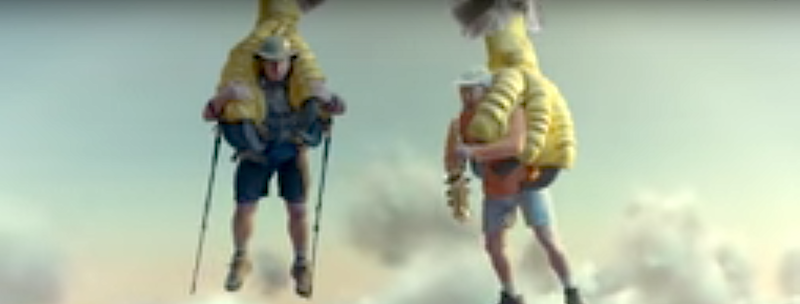
Forest, for example, evolved to a much more emotional and dramatic story. We liked melodrama of it, feeling like it could be like a daytime TV where there was never any doubt that this was a world in which bears and men can be brothers and there are no excuses made. We’re not apologising for it or including a character who thinks, “this is crazy!” No, it’s perfectly possible. So, in that way, there was a fundamental shift.
In Hike, even the edit changed that spot quite a lot. At that stage, we started mucking around with it and it became funnier, and better, and again, tonally so different to the others. Working has never felt more collaborative. You’re kind of crying out for these collaborations with guys who get you and you get them and you make each other laugh. I felt as though we were on the same page the whole time about what we thought was going to work. We’d be very honest with each other and that’s rare. It doesn’t happen all that often. Again, it was all about actively challenging the concept and asking ourselves if we could make the spots funnier or more interesting, and together we did.
Do you have a favourite spot?
Yeah, I think I like Forest the best. I really like that I come away from it thinking “yeah, they’re brothers!” and they shouldn’t be. I like that there’s this world that we brought to life which I find funny, romantic and interesting. It moves in all the right ways and it has the gags in all the right points. I like it when the skinny friend tries to come in and hug and the bear pushes him away, and that you think it’s finished but it hasn’t quite finished yet and there’s another layer. It just gets more and more ridiculous, but it never loses its sense of believability. I like that all four have a very different tone and they feel unique, and in that way you want to watch them because you don’t quite know what’s going to happen in the next one. They all feel different enough and that, to me, supports the progression of the agency’s idea of the campaign.
None of the spots pan out the way you think they should. Deliberately?
We never wanted to lock ourselves into a structure that felt like a predictable skit because you’d always think, “well I know where this is going.” But if you give the audience less information and you give them an image where they think, “what the…?” that’s the kind of response we were going for. So, I think we loosened ourselves up nicely from the thinking that we needed to nail the structure. We started to explore other options.
What was it like working with the agency?
You’re only as good as the people around you, and those guys, they’re as good as they get. From the word “go,” we were pushing ourselves as hard as we could to make these spots as awesome as they could be at every step, knowing that we were up against a lot of factors. They’re also funny guys and we find the same things funny. It really almost boils down to that. Every step of the way it was just a really positive experience and I think the work is better for that. If more people worked that way, the work would be stronger and better because everybody feels respected and listened to. I just had a blast. You have so many experiences where you feel, “if only they could be a little more real or honest or true to themselves.” These guys are and I think that’s why the work is so strong. You just want to try and hold on to them and never let them go. If you continue working together you’re going to keep making great spots together because you’ve found people that you share a like-minded approach with. That’s very rare. They’re great, clever boys.
Creative credits:
Agency: The Martin Agency
Chief Creative Officer: Joe Alexander
Group Creative Director: Steve Bassett
Group Creative Director: Wade Alger
Creative Director (copywriter): Neel Williams
Associate Creative Director (art director): Mauricio Mazzariol
Executive Producer: Brett Alexander
Broadcast Producer: Liza Miller
Junior Broadcast Producer: Coleman Sweeney
Group Account Director: Brad Higdon
Account Executive: Allison Hensley
Production Company: FURLINED
Director: Nick Ball
President: Diane McArter
Senior Executive Producer: David Thorne
Executive Producer: David Richards
Producer: Jason Gilbert
Editing Company: Cut + Run
Telecine: MPC
Animation/VFX: MPC
Music: Black Iris
Audio Post Company: Rainmaker Studios
You might also like