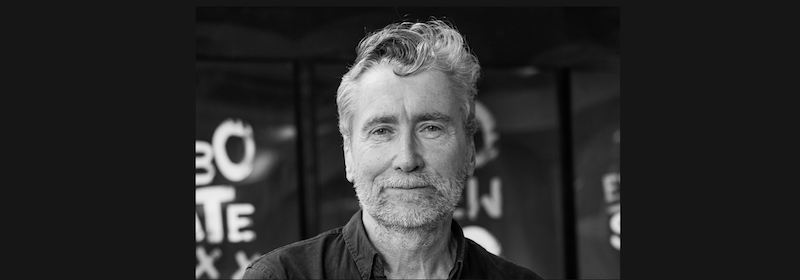

In 2017, with Chou at the helm of creative, Dentsu Taiwan won its first ever Cannes Lion in 2017. Since then it has won 8 Grands Prix in local and regional awards, including AdFest, Adstar, One Show, Longxi, Great Wall, Taiwan 4A, China 4A, China Times International Awards and LIA China Creative Award. Chou was named Outstanding Creative Person of the Year at the Taiwan Advertiser Association in 2017 and named in 2018 Campaign Asia-Pacific’s Women to Watch.
She is jury president of Branded Content & Entertainment at D&AD 2019.
The Stable: There is a lot of branded content in the world. What makes branded content that works, that’s worthy of a D&AD Pencil. What are the “don’ts” for you.
Alice Chou: People have changed. They hate commercials, they don’t listen to you and they skip all the time. But on the other hand, they are now more proactively searching for new information and entertainment contents. Branded content and entertainment let advertisement become new form of involved content and even before they know it is an ad, they have already accepted the intended message. It is a very powerful tool.
Therefore, a Pencil’s work must start from people’s story and not from a product’s story. It has to be very entertaining, make you cry, scared, and make you re-think or discuss important issues. It has to make you forget that it’s an ad. Moreover, it is not just entertainment. Does it work for the brand? What is the brand purpose? You have to skillfully inject the intended brand message in an organic way, so that the audience will receive them without knowing it. This is another important criterion for Pencil’s work.
TS: The work that wins creative awards and the work that wins effectiveness awards don’t always align. Is this a problem for advertising creativity?
AC: This is a long debate issue: winning creative awards not necessarily helping sales? We do witness some of these cases, but we also see other cases in which award winning work actually helped top of mind attention and actual sales. Personally, I think creative awards are not to review how good the product sales are, because there are many other non-advertising factors which will impact sales results.
Creative awards are mainly to encourage people to create new possibilities and use new thinking to solve problems. I believe a brand will never be hurt by good creativity, unless the product has major issues, and great creative work may cause more people to notice it. Creative award winning work, unlike promotional activities, may not be able to create short-term sales results, but it will create a long-term favourable brand image and let audience like the brand, be willing to get close to it and even become its fans and customers.
TS: Why do you think that creativity in Asian advertising has surged upward in the last few years?
AC: I will answer this question as a jury member of Branded Content and Entertainment. In this new world, the internet has connected all of us together. We start to know and learn from each other better, we also start to accept diversity culture. The more we’re becoming internationalised, the more we treasure each unique voice, and I think this is one of the reasons Asian advertising has surged upward in the past few years.
Also because of this connectivity, we Asians know more how to communicate with the outside world and let our thoughts be easily understood by others.
Asians have gradually come to feel that getting to the global stage is not about making our country more internationalized. Actually, we have the most powerful weapon that no other region has – our own unique cultures. Therefore, the Asian work that can express the uniqueness of its cultural charm, and communicate effectively with the outside world, will have more opportunities to be recognised on the global stage.
TS: How important is it for Dentsu Taiwan to participate in a European international awards competition like D&AD?
AC: In the past in Taiwan, we all know D&AD is the toughest award show in the world. We won Cannes Lions, One Show, LIA, AdStars. But we really didn’t know how to crack D&AD. I have the opportunity to come as a jury member this time, which will let me know more about this award show, the techniques for entering and the judging criteria, which will certainly help us to enter in the future.
But above all, is the question of whether our work good enough to win a Pencil. All the top-notch, world scale creative works gather here, and to make a breakthrough, besides budget and execution, I believe we not only need to use our unique culture to create creative competitiveness but also need to avoid the misunderstandings between culture and language (to me, this is the most difficult part). And we need to pay even more attention to each execution’s detail as well.
TS: What makes the D&AD Festival important to you?
AC: Compared with other creative awards, D&AD is very pure and focused. It represents a kind of standard. A very top mountain that every creative person in the world wants to conquer. It reminds all of us, besides pursuing relentlessly the unique and innovative creativity, we also need to go through perfect execution of each detail.
Getting a Pencil is recognition and top glory.
TS: Dentsu Aegis led the merging of creative and media. How is Dentsu Taiwan responding to the new consultancy trend?
AC: We are now talking more about cooperation rather than competition in today’s business world. We need to flight as a group rather than alone. The merger between Dentsu and Aegis is letting our talent pool be richer and possess more state-of-art weapons and tools so that more brilliant business ideas and communications solutions can be generated from a variety of company partners. Data, technology, media and creative all under one roof-opening up all the possibilities to the marketing world.
As we all know, consultancies all started from advisory and strategic planning and it did raised our eyebrows when they began purchasing creative agencies. But we have an old Chinese saying, On a global scene, one will split when we work together too long; when we split too long, we will come together again. As long as we have an open-mind, instead of feeling the threat, we might have a new model of cooperation with the consultancy in the future. That’s what I think.
TS: Ageism is rife in advertising. Why hasn’t age been included in diversity initiatives in the industry. Does it need to be? How could it be?
AC: Yes, it was before. We used to say advertising is the playground for the young because they are not afraid to change, easy to accept new stuff and very curious about everything. But to me, being young is just a state of mind. A person can always stay young at heart, be willing to open up their mind to learn and explore. Their experience can cross the age barrier and find their own battlefield. I don’t know too much about Europe’s situation, but Taiwan is becoming an ageing society and I believe the understanding and knowledge about this ageing population will be a new and powerful source for the senior creative people in the island.
TS: Which pieces of your work are you most proud of?
AC: Single Belief for Glenlivet Single Malt
The short film created by Dentsu Taiwan for The Glenlivet Single Malt, has already won 8 Grand Prix since its debut. Commented on this award-winning 15 min. film, Ted Royer, chief creative officer of Droga5, New York at the time and Grand Jury President of AdFest 2017, said, “It was an unanimous decision for the Grande Lotus winner. Our industry begs for attention: we make deals, offer giveaways, repeat ourselves over again. It’s pretty desperate. This film for [The Glenlivet] is so brave and uncomfortable, I think a lot of people aren’t going to like it. It shows the brand’s confidence, and reminds us to move at our own pace. We hadn’t seen anything like it before.”
Its story:
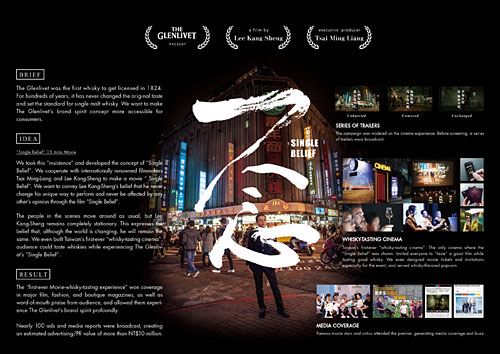
Keeping in line with The Glenlivet’s positioning as “the single malt that started it all”, the 15-minute short film promotes the brand’s unchanging spirit in producing high-quality tasting whisky consistently since 1824. The film featured a collaboration of internationally renowned Golden Lion film winners – director, Tsai Ming-Liang, and actor, Lee Kang-Sheng. Returning to the location of the pair’s first film, Ximending (Taipei), Lee stands still in the crowded streets with a calm and steady gaze despite the curiosity of passersby. Using an experimental filmmaking method to capture the general public’s natural response, symbolic of his steadfast creative vision throughout Lee’s film career, this stance parallels that of The Glenlivet’s Single Belief. The film was screened exclusively in The Glenlivet Whisky-Tasting Theatres, with 28 screenings held across Taiwan. Whisky lovers enjoyed a drink of their preferred spirit while watching the film, reinforcing The Glenlivet’s brand power with every sip.