“A dad is a son’s first hero.” These are the only words that The Sweet Shop director, Noah Conopask’s, film about domestic violence provides. The only words it needs to.
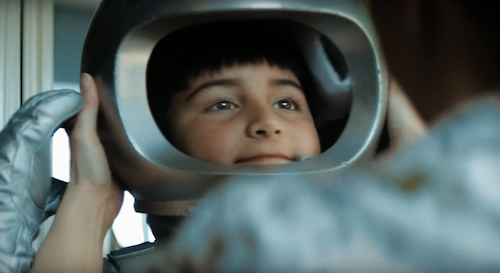
The film, Hero, for National Coalition Against Domestic Violence (NCADV) reveals the trauma for a young boy when his hero is regularly beating his mother. Its story is told by shifting between a boy’s astronaut fantasy, which he shares with his dad, and the harsh reality of his parents’ abusive relationship.
And if it seems particularly real to you, it is. Conopask has skilfully recreated his own story. “The film is autobiographical. The boy is me. I had to make it. Children look up to their parents. Even if they don’t want to. I hope that I can inspire action in those who may be broken or hurt and are acting in this way. I hope I can stir them to look at themselves and recognise what it is doing to their child, their family and themselves.
“It came to me in a rush. I sketched it out quickly in shot by shot writing. The original brainstorm is essentially exactly how it turned out. I feverishly wrote it down in what must have been a few minutes.”
The film is based on scientific evidence that children who witness abuse can suffer permanent changes to their personalities. They don’t even have to be hit themselves.
According to US statistics, one in 15 children there is exposed to intimate partner violence each year, and 90% of these children are eyewitnesses to this violence.
This is Hero’s behind-the-scenes story, by Noah Conapask:
What was your approach to making the film?
Super DIY. Every component had to be so perfect. The budget wasn’t big, so we had to be very smart about how we spent every cent.
How did you bring to life the balance between the boy’s imagination and the reality of the parent’s violent relationship?
The middle of the film rocks you back and forth between the boy’s imagination and the reality. This contrast serves that purpose, but also comes from out of nowhere and really draws you in because you don’t know what you are watching anymore.
I spent a lot of time on set with Sebastien. Always walking him through each scenario before we shot and then working with him closely between takes for adjustments. We spoke a lot about what was real and what wasn’t. And we’d talk about things in his life that made him feel a certain way and then tap into those memories and ideas to tune his performance.
What was the casting process like? What did you look for to capture the emotion in the story?
I knew straight away that the casting and performances were everything for this film. Each character had to essentially play two roles – their fantasy and true selves.
I wanted a boy who would give us all the intricate and big emotional moments the script called for. Truly tender happiness and love for his parents and a kind of emptiness when we see him in his true reality. I also wanted him to have a visual element to him. Sebastian has these giant black eyes that are almost alien. It’s a subtle detail, but I was drawn to that.
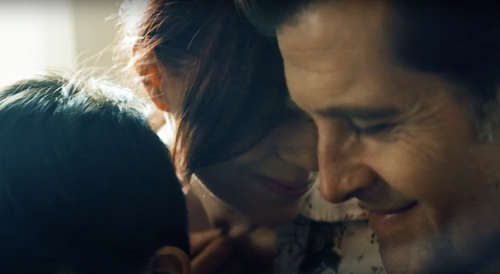
For the father, I wanted someone who looked sweet, but also kind of broken. Who could capture the essence of what a child’s perception of what a great father is and then immediately became a violent monster.
The story is mostly a father and son experience, but I wanted the mother to be an active participant, not just a victim. In these types of tragic homes there is a complacency, participation and co-dependency that can be just as horrific.
For casting, I brought in a mum, dad and son. I mixed and matched, looking to see who had the most chemistry. We would run through different scenes and I would get right there in the mix and guide each performance. I gave the kids special attention and would get down on the floor with them or crawl under a table so I could be right there and really rest their range.
What were you trying to evoke with the cinematography? What were the structural and emotional needs of the story?
There are two worlds we were creating here, the child’s fantasy and the family’s harsh reality.
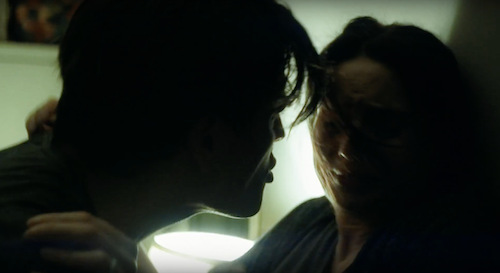
I wanted to create an idyllic happy and loving dream look that felt safe and soft that I hadn’t seen before and I wanted it achieved in camera without heavy handed practical or post effects. We shot anamorphic and cropped in camera to 16×9. I loved the smeary style and dreaminess of anamorphic, but not the wide frame. We maximized this in the DreamWorks as much as possible. I wanted the height of 16×9, which was better for the portraiture I was after in this film. The film in this section was graded more saturated for a more idyllic look.
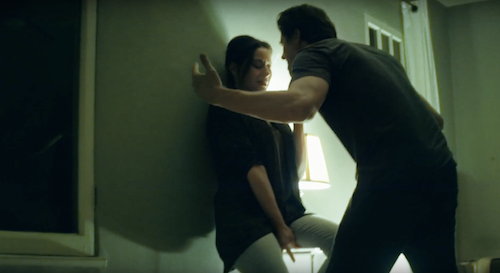
We smash brutally into the real world and along with the violence there is a marked change in the look. The dreaminess is gone. We see more of the environment in focus. There’s no hiding the reality here. It’s grittier and grimier. The lighting harsh and unflattering. The color is more desaturated green and muted. It’s cold and empty, even the walls are bare, but the father and mother look like it’s humid and sticky. It’s just uncomfortable all around.
It’s a mixture of over cranked and real time.
What were the trickiest components during the creation of the film and how did you overcome them?
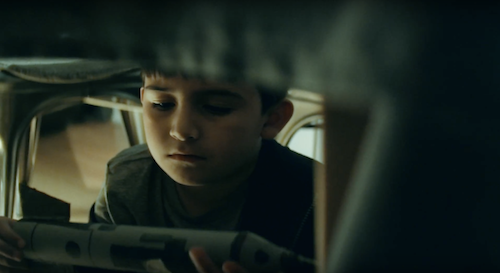
Constructing the rocket. Making that an interesting set piece that you would want to get into.
Finding a location that was the right scale, tone and feel. I loved how this house had a long white hallway with x grid patterns in the wood. I thought to myself, it’s like a rocket bridge!
And the track? What was your thinking here?
It had to be something dreamlike and beautiful, but also unstable, like it could fall apart at any time. Wandering. Classic, yet totally unique.
What are your hopes for this film?
Children look up to their parents. Even if they don’t want to. I hope that I can inspire action in those who may be broken or hurt and are acting in this way. I hope I can stir them to look at themselves and recognise what it is doing to their child, their family and themselves.
Credits:
Client: National Coalition Against Domestic Violence
Production company: Chirp Films
Director: Noah Conopask
Executive Producer: Laura Thoel
Producer: John Malina
Production manager: Mario D’Amici
DoP: Garrett Hardy Davis
Sound designer: Gavin Little
Editor: James Dierx (Whitehouse Post)
Production designer: Alex Choate
Wardrobe stylist: Marissa Adele