France is the world’s fashion capital. The country is known for its craftsmanship and its luxury goods are famous worldwide. For a number of years, the French government has been promoting products made in France and sold abroad.
But fashion isn’t all that France is spreading throughout the world. There are weapons too. And while the framework they’re sold in is regulated, it’s actually only heeded a little.
Despite ratifying the international Arms Trade Treaty (ATT) in June 2014, the French government has continued to sell arms to countries that then use them against civilians. Which means France is involved in war crimes.
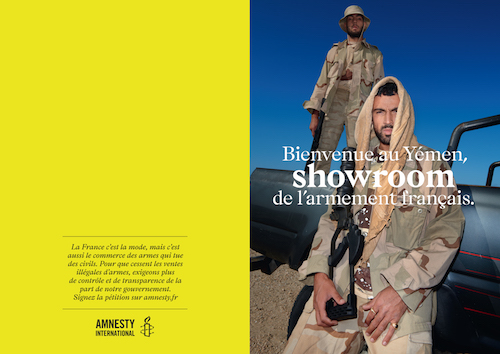
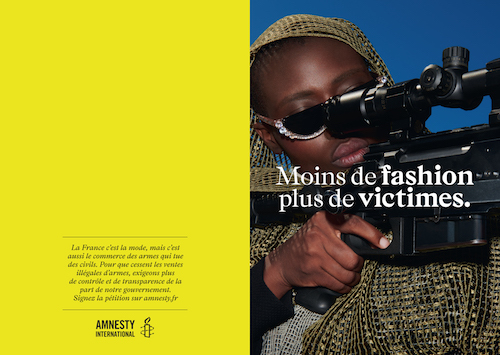
To remind the government of its responsibilities and obligations, and to raise awareness among the general public, the charity, Amnesty International France, and agency, DDB Paris, have launched a campaign that calls out the French Government on its indifference and compares the fashion industry to the arms trade.
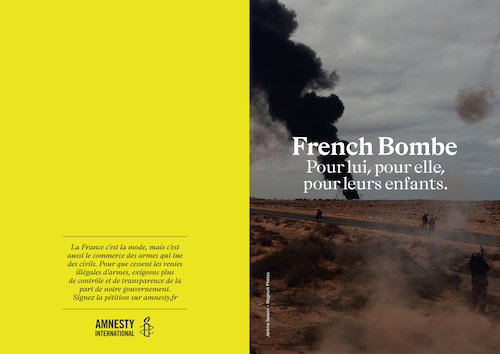
The campaign is taking its cue from a petition demanding greater transparency from the government and concrete actions to better regulate its exports of military goods.
The campaign’s posters were launched on September 23, just as the Paris Fashion Week kicked off so that they appeared alongside French fashion’s big names.
The facts:
As the world’s third-biggest arms-exporter, France should be respecting the ATT, which was signed and ratified in June 2014 to ban military goods from being transported when there’s a risk of international humanitarian law and human rights being seriously breached.
But it turns out that the French government has carried on selling arms to several countries that then use them against civilians.
- Saudi Arabia and the United Arab Emirates are among France’s key clients, as are players in the Yemeni civil war, described by the UN as “the world’s worst humanitarian crisis”.
- Egypt—another country violating human rights among civilians—is also one of the French government’s loyal clients.
Unlike France, several European states have, since 2017, stopped selling or transporting arms to nations that stand accused.
- Under pressure from public opinion, three countries—the Netherlands, Belgium (Flanders) and Greece—have reacted by partially or fully suspending their sale of arms to Saudi Arabia and the United Arab Emirates.
- Austria, Ireland, Sweden and Switzerland have introduced restrictions on exports to Saudi Arabia.
- Four other countries—Germany, Norway, Finland and Denmark—have announced they’ll be suspending their transport of arms to Saudi Arabia.
The French government is digging its heels in. It claims to abide by its undertakings even as investigations and revelations like that of Disclose in 2019 prove, one after another, that the country is flouting the ATT.
Credits:
Agency: DDB Paris
Executive Creative Director: Alexander Kalchev
Creatives : Patrice Dumas & Caroline Lorin
Account Management: Marine Hakim, Coralie Bouillier & Camille Passot
Producer : Pia Schneider
Print Producer : Corinne Vulliez
Photographer : Mous Lamrabat
Production : Handsome
Producers : Marie Juncker & Sam Fontaine
Social Media & Influence: Andréa Meyssirel & Sébastien Balongrade
Client: Amnesty International France
Client Management: Caroline Lutz & Arnaud Humblot
Social Media & Influence: Soundous Jeljoul & Etienne Jolivet