[by Asheen Naidu, executive creative director, BWM Dentsu, Sydney]
Even after 20 years in the business, I still get giddy with excitement when awards season comes around. I know it’s not politically correct or even cool to focus on awards, but my interest lies less in who’s won what or whether it promotes an industry patting itself on the back, but more with the magic of the ideas themselves. Each year brings a fresh batch of thinking that stretches my brain with their uniqueness, gutsiness, weird and wonderfulness and downright genius-ness. (I’m a copywriter so I’m allowed to make up words).

2017 didn’t disappoint. While there were the well-known gems like Meet Graham, Fearless Girl and Superhumans, there was also a handful of pieces that inspired me to send them around in an all agency email or post them to my social channels. For the purposes of this article I’ve decided to focus on a particular niche that I noticed this year. What I loved about all of them was the simplicity of thinking. We often try to reinvent the wheel in advertising, believing that we have to start from scratch to be original. The teams behind these pieces were really great observers of human behaviour and aware of the worlds within which their audiences play. And they all found a really clever way to adapt those worlds ever so slightly to reach their audience in a completely fresh way.
Simplicity of thought meets winning observations of human behaviour…
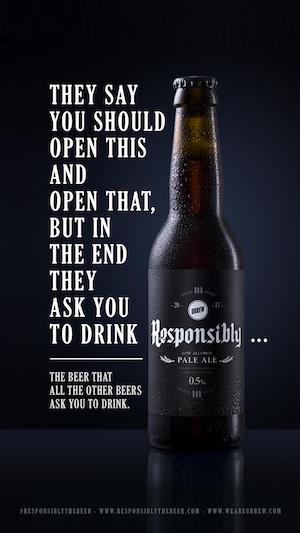
The first example is for Ubrew, a small brewing company based in London. Having a much smaller marketing budget than the bigger players, it cleverly took advantage of other beer brands that always end their communications with a “drink responsibly line” and so created a new beer called, you guessed it, Responsibly. By playing off every other beer ad in the world, it established its positioning of Responsibly. The beer all other beers ask you to drink. Worked wonders on social media. Simple. Brilliant.
The Immunity Charm was one that appealed on an emotional level. Afghanistan has an infant mortality rate of 101 for every 1,000 births and perhaps not surprisingly, a vaccination completion rate of just 50%. Remote areas, illiteracy and traditional biases against vaccines were the source of the problem. Knowing all of this, the Ministry of Public Health came up with a simple, effective solution. Borrowing from an Afghan tradition, they modified an Evil Eye charm bracelet, commonly placed on a newborn’s wrist to ward off evil spirits, to spread the message of immunisation amongst various Afghan communities. By providing kits to doctors, they could add a charm to the child’s bracelet for every vaccine they administered. In this way, the Immunity charm became an immunisation history of the child, actually worn by the child. In one simple idea, it solved the problem of biases against vaccines, parents not keeping up with immunisation records and doctors from any region knowing exactly what the child was already immunised against.
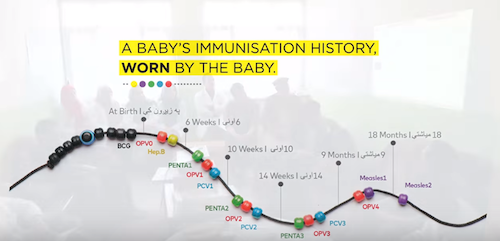
What I particularly liked was that rather than try to create some new platform or way to communicate the need to immunise, the team looked to the everyday lives of their audience and adapted something that already existed. They used human behaviour and cultural insight to decide their channel of communication.
…also worked for us.
While contextually different, our agency used similar exploration of our target audience behavior in developing our award-winning piece for our BabyLove client, called Premmie Proud. By interviewing groups of parents of premature babies, we uncovered that most premmie parents feel uncomfortable sharing pics of their newborn babies on social media for fear of what people would think or say. In our mission to make all premmie parents Premmie Proud, we partnered with the world’s largest photo sharing app, Baby Pics, and created a new set of message overlays specifically for premmie babies. Messages like “Lightweight champion of the world,” and “You say Premature, I say ahead of my time,” allowed parents to proudly share their little miracles with the world. There was a lot of talk upfront about creating our own app, or finding a brand new piece of innovation, but when we looked closely at the actual day to day lives of our audience, all it took was adapting a familiar channel of communication to get over 10 000 parents to proudly share their premmie pics in just the first 3 weeks.
Another really clever use of existing platforms was the Unsafety Check by the activist movement Black Lives Matter. With the spate of police killings of innocent Black men in America, the organisation wanted to show just how unsafe Black people felt in America. So, they hacked Facebook’s existing safety check functionality to create a web app that allowed people to mark themselves unsafe. And by sharing the issues of Black Lives Matter with family, friends and all their followers, it made the message personal. It was a simple yet powerful way for Black people to express how they feel on a massive scale.

While I’m a fan of great ideas in general, the kind of thinking expressed in these pieces really caught my eye this past year. Work that’s aware of its surroundings and subtly manipulates it to make its point powerfully. I’m hoping this new awards season brings even more brilliant thinking and I for one can’t wait to see what 2018 has to offer.
You might also like