“PlantBottle packaging is the latest breakthrough from The Coca-Cola Company designed to change the way the world thinks of plastic bottles. It is the first ever fully recyclable PET plastic beverage bottle made partially from plants. The material looks and functions just like traditional PET plastic, but has a lighter footprint on the planet and its scarce resources.”
Well, it was new in 2009 and it hasn’t yet changed the way the world thinks of plastic bottles. But now it has an advertising campaign. So it will be interesting to see what happens next.
Ogilvy New York has created a print campaign to promote Coke’s Plantbottle. Each is reminiscent of Coke Hands that Jonathan Mak Long created for Ogilvy Shanghai for Coke in 2012. The timing is apt – that poster won the Outdoor Grand Prix at Cannes.

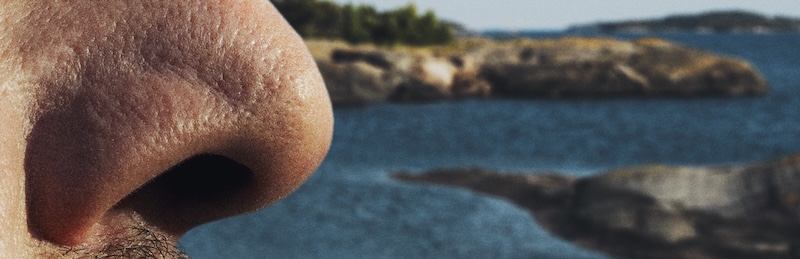
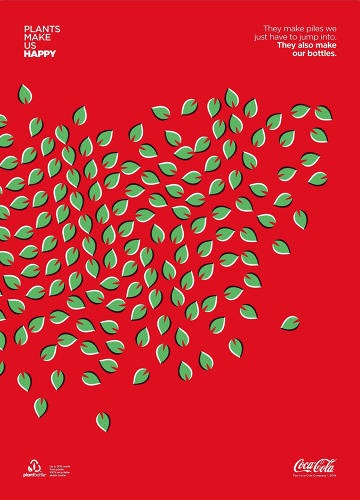
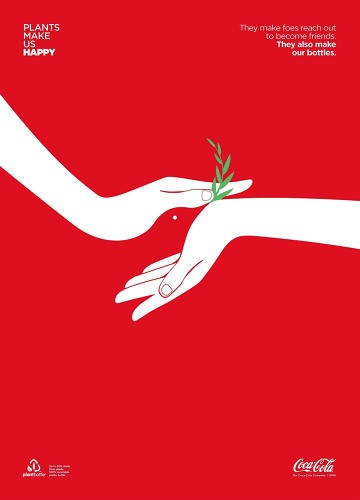
There are four ads in the new campaign. One shows two hands holding a plant – its negative space shows a bird with a plant in its beak. The second is a bunch of fluttering leaves. The third shows a kiss between two heads – the space between creating the shape of a flower. The fourth is a pencil that is connected visually to its origins as a tree.

All the ads wear the line, “Plants make us Happy.”
Pencil/tree ads, “They become tools that make us smart. They also make out bottles.” Fluttering leaves ads, “They make piles we just have to jump into. They also make out bottles.” …And so on.
Creative credits:
Chief creative officer: Calle Sjoenell
Executive creative director: Corinna Falusi
Design director: Lucas Camargo
Associate creative directors: L Justin Via, Evan Slater, Abe Baginsky, Maite Alburquerque & Emily Clark
Art direction: Anti-Anti, Lukas Lund, Andreas Hoff & Carl Versfeld
Producer: Jessica Fiore
P.S.: Remember when Coke was less about sharing happiness and more about warring with Pepsi?
In 2009, Coke’s Plantbottle was 30% plant-based.
So in 2011, Pepsi announced that it had worked out how to make fully recyclable, 100% plant-based bottles from switch grass, pine bark and corn husks. It also stated that it planned to eventually use oat hulls, potato and orange peels, and a variety of other agricultural by-products from its Quaker and Tropicana brands. In 2012.
Coke said it didn’t care. It already had 2.5 billion of its 30% plant-based bottles on the market, while Pepsi wouldn’t begin pilot production of its new bottle until 2012.
Pepsi’s Green Bottle has never appeared, but two months ago PepsiCo filed a patent which described a method for making beverage bottles from paper fibers.
In 2012, when Coke was talking about a 100% bio-based Plantbottle, the following info came to light: “It will still be highly recyclable, non-biodegradable PET plastic, just from all renewable feedstocks. However, making PET from any feedstock contradicts the principles of green chemistry. PET production requires p-xylene, a hazardous chemical linked to brain damage in newborn lab animals. Workers are exposed to p-xylene.”
Coke had put 15 billion Plantbottles into the market by mid-2013 – before it launched Plantbottle into China. 25 countries were then using Plantbottles. By 2020, Coke plans to make all of its PET bottles using first-generation PlantBottle material.
You might also like