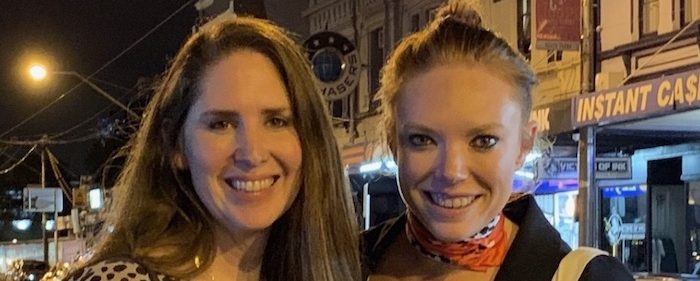
The Stable talks to Annie Price, creative director and Jess Lilley, associate creative director, at J.Walter Thompson Melbourne and Dillan Golightly, festival director at Melbourne Queer Film Festival about making cause advertising in an era of cause advertising plenty.
Cause advertising is not a slam dunk…for either creativity kudos or effectiveness applause. It takes hard slog and lashings of ingenuity, often stitched together with very little money.
This is what J.Walter Thompson Melbourne and the Melbourne Queer Film Festival achieved with those three ingredients:
The Stable: Cause advertising is very popular. Is adland saturating the market, making it harder to get through?
Price & Lilley: Cause related advertising has always been popular for agencies but it’s more accountable now – so it’s less about a stunt and more about producing work that works. More now than ever, mobilising a crowd online is a big focus for causes and we are hit with a lot of worthy messages. If we can use our commercial skills to help the right cause get a message to the right audience and move them to act somehow, then that’s not a bad thing. For a brand like MQFF, they don’t have the budget to make an impact via traditional advertising routes. And with a skeleton staff whose primary focus is putting on a good film festival and chasing funding, we can help them get their message to a new audience. We were able to come up with an idea and a path to prospective audiences that they wouldn’t have thought of, but that really worked. As long as ad agencies remain focused on getting the results a cause needs with great ideas, then it’s all good. If it works, it works.
TS: Dillan, What are the biggest challenges you face right now?
Dillan Golightly: Melbourne is one of the most cultural cities in the world. Which is great for Melburnites but it makes it difficult for a festival like ours to stand out. We compete with a lot of other worthy festivals for funding and we operate on a shoestring. When we come up against some of the bigger festivals (like the Melbourne Comedy Festival which was on at the same time this year, or Melbourne International Film Festival) it can be tough – we just don’t have the budget to compete with events that size. Plus we’ve been around for 26 years, which is pretty remarkable. But it means that we have to keep thinking of new ways to stand out from the crowd – our programming continues to be incredibly challenging and innovative and the festival is at a great stage but we want to grow it.
TS: What are the biggest communications/message challenges you face?
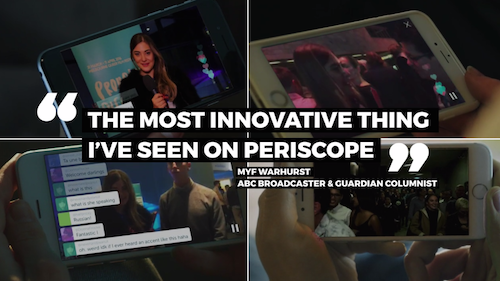
DG: We really want to reach new audiences. Melbourne is such a great city and people love the arts – but it’s hard to get in front of new people especially when there’s so much going on in the city. We are really trying to open up the Festival and to get to new people who haven’t heard about it and also people who have heard of us – but have a perception about what we are. So changing perceptions for some and getting in front of new people. With limited budget to do this it means we have to be really clever with our campaigns.
TS: JWT, Where did the idea for the MQFF campaign come from?
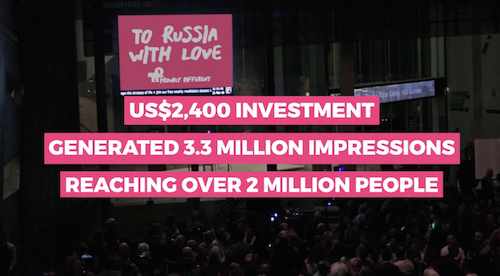
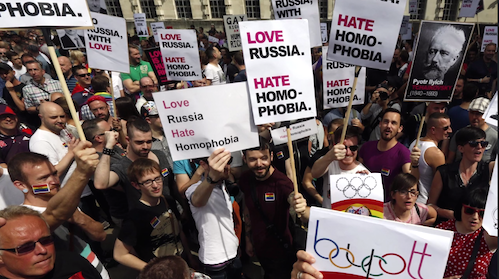
P&L: We were challenged to make the festival relevant to young people again. A core, passionate audience had followed MQFF over its 26 years and, while the festival’s programming is as groundbreaking as ever, it needed to get noticed by a broader audience. We realised that the festival began when mainstream cinema was overwhelmingly hetro and Australia as a society was very hostile toward the queer community. So starting a queer film festival back then was a really rebellious and big-hearted thing to do. Even though Australia still has a fight on its hands with marriage equality, we wanted to remind Melbourne how far we’ve come and how important events like MQFF still are in providing safe, supportive environments in which to celebrate queer voices. So we decided to turn our attention to a country whose queer community is still facing open discrimination and aggression. To Russia With Love was born when we hit on the idea of inviting Russia’s entire queer community to MQFF’s opening night, via Periscope.
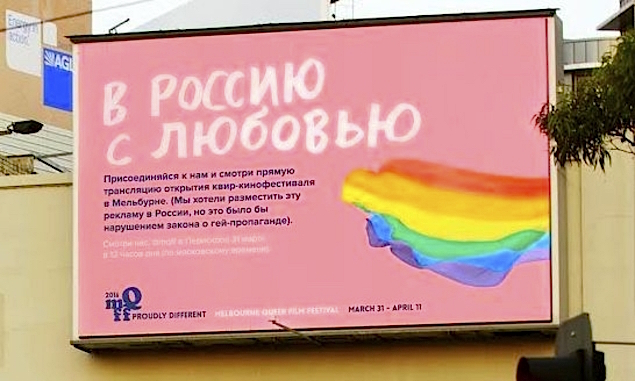
[Translation: To Russia with Love, please join our live-stream of the opening night of the Melbourne Queer Film Festival. (We wanted to put this up in Russia but it’s illegal.]
TS: What decisions led you to choose the type of campaign (billboard)?
P&L: Originally we wanted to put billboards up in Moscow, advertising the livestream. We liked the idea of a little Melbourne festival taking it to Russia! When we realised Russia’s gay propaganda law made that illegal, the campaign really shifted focus for us. Straight away we knew we had to defy that law. We had to put the billboards up in Melbourne, still written in Russian, to show some true solidarity with Russia’s queer community and really get Melbourne involved in getting the message to them. We know Melburnians love a good social justice fight and we figured that getting them to be the carriers of this message might also get them to consider supporting the festival. And thankfully it did. Images of these billboards made it all the way from the streets of Melbourne to Russia. PR helped, but a lot of it was people sharing it. And as a result, Melbourne came to MQFF in record numbers, with opening night selling out, the best festival box office in five years and a much younger and more diverse audience attending than in previous years. The best result, though, came when we were filming for the live broadcast on opening night at MQFF. Seeing messages pop up on the Periscope feed in Russian, and Melbourne’s queer community show so much love and support to their Russian comrades, was unforgettable.
TS: What do you think are essential ingredients for effective cause advertising?
P&L: Being really clear about what you want to achieve. ‘Raising awareness’ can be a double-edged sword. If you’re not really sure about what you want people to do when you’ve got their attention, it can set you on a course to create something that, on the surface appears very meaningful, but really isn’t an agent for change. With MQFF, our campaign came out of some really clear objectives. We needed to engage a young, socially aware audience and get them to recognise it can still be a political act to support a queer film festival. We also had no budget. Sometimes that really helps you focus! I think another key ingredient is belief in what you’re doing and the change you want to be part of. If you’re going to fight for a cause, you really need to have your heart in it. It should never be a cynical marketing exercise. The whole team at JWT believed passionately in MQFF and spent very long hours working for the cause. And finally, it might seem really obvious, but make sure your cause is genuine. The best campaigns are strong ideas born from a real insight or brand truth, then you need to tell that story well. Having a cool creative idea and trying to find a cause to tack onto it can end badly for everyone.
TS: Dillan, With the recent horror killing in the US, the gay community is getting a lot of attention in news media. How will this affect your job?
DG: I’ve been in the job for one year now and one of the questions I’m continually asked is, ‘Why do we need a queer film Festival?’. I think when you look at the events that have happened in Orlando you realise that even in developed countries where marriage equality has been achieved that homophobia still exists. For me, it just makes me feel more strongly that we do need a safe space for the community and that MQFF provides a space for LGBTIQ people and allies to come together, but also has a place in challenging and educating wider audiences. so for me I think it gives more purpose to my role.

TS: Brands played a huge part – and did very well – at D&AD in Creativity for Good. Judge, Richard Bullock said, “I was reviewing conceptual design ideas, innovations, social behaviour change, movements…things that were so much bigger and more complex than a show about ads for good causes. It was much deeper than that.” Do charities/NFP’s need to up their game?
P&L: It’s funny, one of our really good art directors at JWT recently moved to an in-house team with a not-for-profit…maybe we’ll see more of that? There are big charities who have always been great at using the language of design and commercial communication to make people feel or act or to simplify a complex message. Now, with people’s hunger for information and online content, and a diversification in the way people receive news (and what constitutes news), in some ways it’s never been easier to bring a powerful message or movement to a big audience. But, of course, this brings many complications. Competition for people’s time, a proliferation of content and crowd sourcing, all cause fatigue and trigger a tendency to switch off if the message is complex. It makes it a lot harder for many causes to stand out. A good headline and powerful image are not necessarily going to cut it anymore. Charities need to stop thinking of themselves as charities and think like any other brand, taking people on a much bigger journey and earning their loyalty.
TS: What do you think are essential ingredients for effective cause advertising?
P&L: Being really clear about what you want to achieve. ‘Raising awareness’ can be a double- edged sword. If you’re not really sure about what you want people to do when you’ve got their attention, it can set you on a course to create something that on the surface appears very meaningful but that really isn’t an agent for change. With MQFF, our campaign came out of some really clear objectives. We needed to engage a young, socially aware audience and get them to recognise it can still be a political act to support a queer film festival. We also had no budget. Sometimes that really helps you focus! I think another key ingredient is belief in what you’re doing and the change you want to be part of. If you’re going to fight for a cause, you really need to have your heart in it. It should never be a cynical marketing exercise. The whole team at JWT believed passionately in MQFF and spent very long hours working for the cause. And finally, it might seem really obvious, but make sure your cause is genuine. The best campaigns are strong ideas born from a real insight or brand truth, then you need to tell that story well. Having a cool creative idea and trying to find a cause to tack onto it can end badly for everyone.
TS: What cause campaigns (globally) in the last few years have had a particular impact on you?
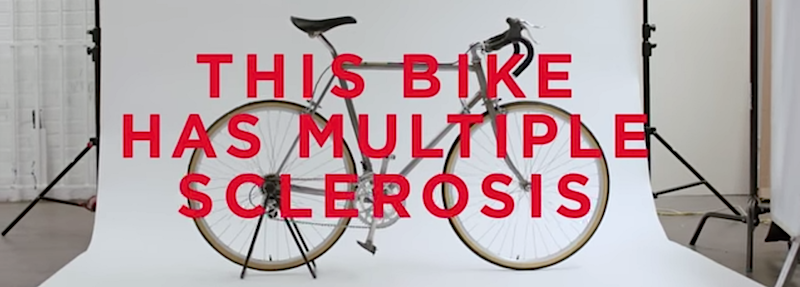
Annie: It’s a recent one so it’s top of mind. I love This bike has MS. It’s a really intriguing, smart way of depicting the daily difficulties people with MS face. I worked on MS years ago and remember the challenge of communicating a disease that can often manifest without any visible symptoms. The bike analogy is a ripper. And it makes the point loud and clear without relying on too much emotion. The storytelling was bang on. And it had good stretch. Building the bike allowed them to communicate the battles of MS sufferers, then challenging people to ride it for fund raising gave it a life of its own. A lovely insight, well conceived.
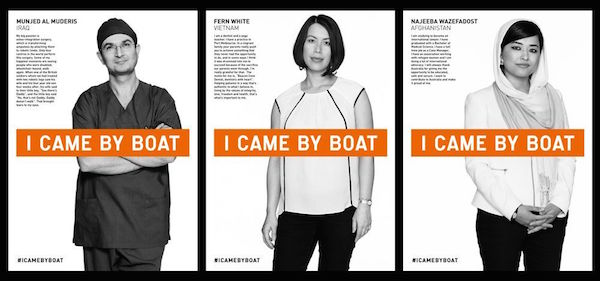
Jess: A campaign I’ve got my eye on at the moment is I Came by Boat. It’s a local campaign initiated by a former refugee (now make-up artist) and a group of advertising professionals, and is designed to give a human face to the rhetoric around refugees and asylum seekers in Australia. It’s well shot with a clean design and has a very positive message – simple, powerful and to the point. I applaud anyone who can make an impact with a grass roots message during an election cycle so will be interested to see how it goes.
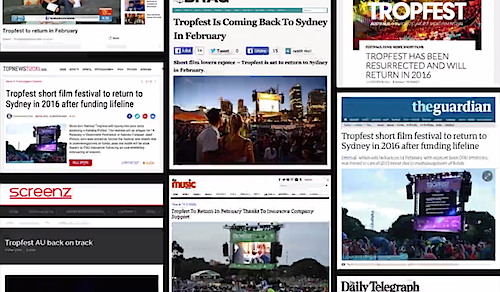
I also thought it was smart of CGU to step in and resurrect Tropfest in January after it was cancelled. People don’t generally look too kindly on insurance companies, so to save Australia’s most popular short film festival was a win-win for the brand and the community.
Read Cause advertising: It’s all good, isn’t it? Parts 2 & 3:
Cause Advertising: It’s all good, isn’t it? Part 2. Interview with Barnardos and Ikon
Cause advertising: It’s all good, isn’t it? Part 3. Ogilvy Sydney & NBCF
Cause Advertising: It’s all good, isn’t it? PART 1: Interview with J.Walter Thompson & MQFF
You might also like